

By Jackie Stapleton
Aaron Amick served as a submarine sonar operator with the U.S. Navy. He now runs the YouTube channel “Sub Brief,” where he explains what submarine crews do and how they train.
In his video “What It’s REALLY Like Hunting Enemy Submarines,” Amick describes sonar school. Training starts with the basics: analog equipment and old recordings played on reel-to-reel tape. No sophisticated systems yet, just trainees learning to recognize and classify sounds using their ears.
Instructors add harder material as the weeks pass. Trainees learn to tell a merchant vessel from a warship, and to pick up on the sound of machinery, propeller characteristics, and the rhythm of a ship’s engines.
Understanding the theory is not enough. Each trainee must prove they are able to hear a recording, interpret it correctly, and make the right classification, often under pressure. Not everyone manages this. Some people pick up pattern recognition in sound with apparent ease; others put in the same hours and still struggle. Sonar school has a genuine washout rate. Trainees who do not meet the standard do not graduate.
The skill sits in the ear, not on the page. A recruit who studies every description of propeller noise still needs the hours of listening before the difference registers.
What do your most experienced people hear that they have never had to explain?
Tacit knowledge is like knowing where to make the chalk mark
There’s a frequently told story about the engineer Charles Steinmetz and Henry Ford concerning a factory machine no one had been able to fix. Steinmetz was called in, listened to the machine, made some calculations, and then marked a spot on the side with chalk. He told the engineers to remove a panel at the marked spot and adjust the wiring inside. The machine started working.
His invoice arrived in the amount of $10,000. Ford asked for an itemized bill. Steinmetz sent one back:
- Making the chalk mark: $1
- Knowing where to make the mark: $9,999
The story has been told about different people in different trades for more than a century, and the version naming Steinmetz and Ford has never been confirmed against a primary source. What keeps the story alive is the idea inside it. The value was never in the chalk. It was in years of listening, testing, and learning what a working machine sounds like. That experience allowed one person to locate a fault everyone else had missed.
Dorothy Leonard and Walter Swap, authors of Deep Smarts, discuss the same problem in their interview for ACM’s Ubiquity magazine. They describe a specialist physician whose judgement on fitting contact lenses after eye surgery was never fully passed on to her long-time associate before she died, leaving a gap in care that experience alone had filled.
The four stages of competence
The four stages of competence model describes how a skill moves from something a person is not yet able to do, without knowing the gap exists, to something they do without conscious thought. In ISO 9001, clause 7.2 (“Competence”) asks an organization to determine and evidence the competence people need. Also within ISO 9001, clause 7.1.6 (“Organizational knowledge”) asks to identify and protect the knowledge organizations depend on. Risk sits at both ends of this curve, not only at the last stage: at the start, before a gap is visible to anyone, and at the end, once competence has become too automatic to explain.
This is not a new model. Noel Burch developed it at Gordon Training International in the 1970s, building on earlier work by management trainer Martin Broadwell, and it is used here as a base framework rather than something original. The diagram below sets out the four stages side by side. Gaps go unnoticed at the first stage, before a person or their organization can see what is missing. Knowledge walks out the door at the last stage, once competence has become so automatic that nobody thinks about writing it down. The two stages in between are where competence is most visible, and where most competence management already happens.
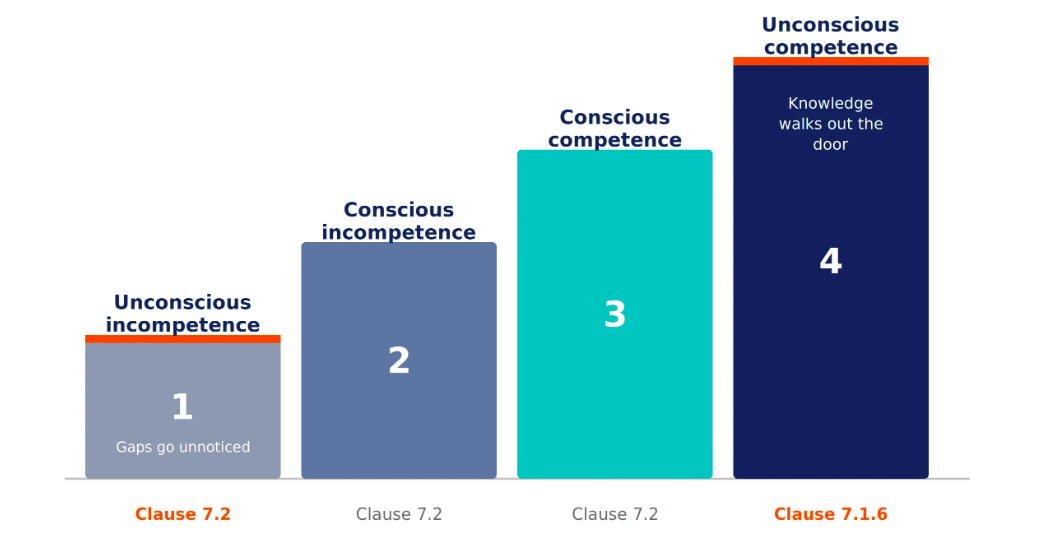
- Unconscious incompetence. At this stage a person does not know what they do not know. A new starter follows a procedure without understanding why each step matters and is unable to see the gaps in their own performance. Clause 7.2 exists partly for this reason: Competence needs to be determined and verified by the organization, not assumed or self-reported, because the person least able to judge their own competence is the person who has not yet developed it. Left unchecked, this is where nonconformances start: work that looks fine to the person doing it, and only surfaces as a problem once an audit, a customer, or a downstream process catches what they missed.
- Conscious incompetence. The person now sees the gap between what they are able to do and what the role requires. This is where documented procedures, work instructions and training carry the most weight, because the person is actively relying on them. Not everyone closes this gap at the same rate. Aaron Amick’s sonar school had trainees who picked up pattern recognition quickly and others who worked equally hard and still did not qualify.
- Conscious competence. The person is now able to perform the task correctly but still has to think about it. They follow the steps, check the reference, work through the logic. This is the most visible stage of competence, and the easiest one to audit, because the person is able to explain what they are doing while they do it.
- Unconscious competence. The task now happens without conscious thought. Aaron Amick’s sonar operators reach this stage when they hear the difference between a merchant vessel and a warship before they are able to explain how. The same shift happens in a quality role: An experienced inspector can tell a batch is drifting out of specification from the sound of the line or the feel of the product in their hands, well before the measurement confirms it. In a similar way, a seasoned auditor can sense a nonconformity in how a team talks about a process before finding the objective evidence to support it. This is genuine competence, and it is also the point where clause 7.1.6 becomes urgent: The knowledge the organization depends on most is now sitting in a form the organization is no longer able to see, held by a person who might not think to write it down because it no longer feels like knowledge to them at all. It walks out the door the day they do, unless someone has deliberately captured it first.
The chalk mark on the generator only made sense to the person who no longer needed to think about where to put it.
Next steps for you
- Start recording real activity, not attendance. Pick one task and capture what someone did, what they learned, and what support they still need.
- Bring in a second set of eyes to verify it. A reviewer should confirm what they observed and how independently the person is now able to perform, not just that training happened.
- Flag the knowledge worth keeping. When an entry reveals something only one person knows how to do, mark it for capture before that knowledge walks out the door.
About the author
Jackie Stapleton is the director of Auditor Training Online and holds multiple Exemplar Global certifications.
A version of this article first appeared on the Lead the Standard blog and is published here with permission.