

By Josh Casson
Modern management systems are complex. Standards such as ISO 9001, ISO 14001, ISO 13485, and ISO 27001 contain many requirements that touch almost every part of an organization.
Many organizations still manage these requirements through tribal knowledge, disconnected procedures, or the assumption that someone else is handling them. That may seem to work for a while, but it often leaves gaps that stay hidden until a customer audit, certification audit, or regulatory inspection finds them.
The real challenge isn’t just meeting requirements. It’s being confident that every applicable requirement has been identified, assigned, implemented, and maintained.
This is where the requirements matrix becomes invaluable.
Ensuring nothing falls through the cracks
A requirements matrix is a roadmap.
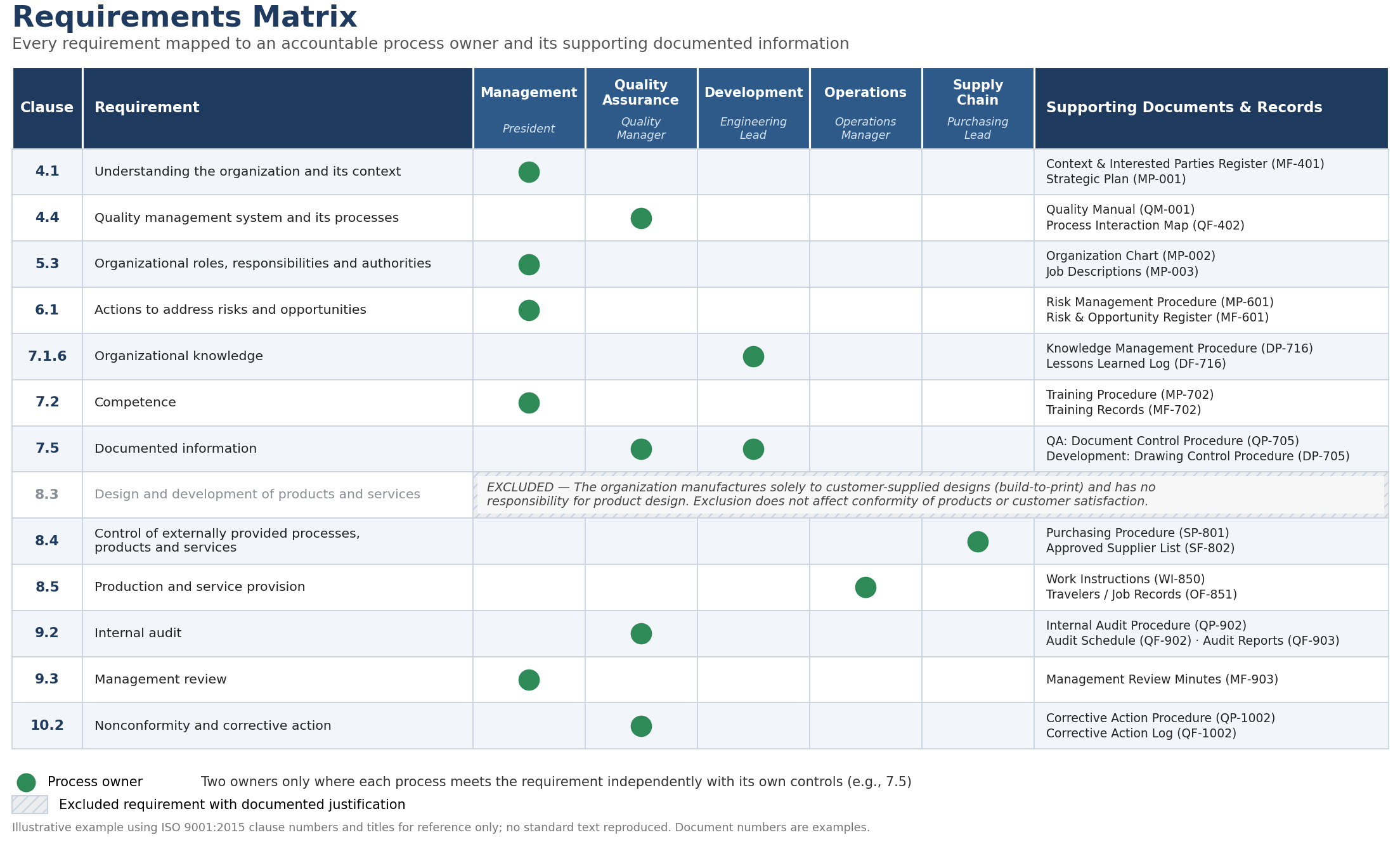
It breaks a standard, regulation, or contract into individual requirements. It then maps each one to the processes, procedures, records, and controls that satisfy it. Instead of relying on assumptions, organizations can show exactly how each requirement is met.
A well-developed matrix answers questions such as:
- Which process satisfies this requirement?
- What documented information supports compliance?
- Who owns the requirement?
- Has the requirement been intentionally excluded, and if so, why?
This visibility is hard to overstate. Requirements that aren’t mapped often end up as findings.
Because the matrix makes an organization review every requirement one by one, it greatly lowers the risk of missed obligations. It also gives a much clearer picture of how healthy the system is overall.
Creating accountability through process ownership
One of the most overlooked benefits of a requirements matrix is how clearly it defines process ownership.
Many nonconformities, recurring issues, and compliance failures aren’t caused by missing procedures. They’re caused by confusion about who is responsible.
When several departments assume that someone else owns a requirement, no one takes responsibility for ensuring that it is implemented and maintained.
A strong requirements matrix removes that confusion. Each requirement should have one named owner who is accountable for implementing, maintaining, monitoring, and improving it. In rare cases, two owners may share responsibility when they independently manage distinct portions of the same requirement. Document control is a common example: Quality assurance may oversee management system documents, while engineering controls product- or service-defining documents such as specifications and drawings. Each function is responsible for ensuring that its documents are properly maintained, approved, controlled, and distributed.
This accountability has several advantages:
- Process owners understand their responsibilities.
- Management can quickly see who should address an issue.
- Training can be targeted at the right people.
- Auditors know where to look for evidence.
- Corrective actions can be assigned with confidence.
Most importantly, clearly assigned ownership makes compliance a shared organizational responsibility rather than a project managed solely by the quality assurance department.
The critical role of exclusions
A requirements matrix is also valuable for managing exclusions and requirements that don’t apply.
Not every requirement applies to every organization. The key is that exclusions must be deliberate, justified, and documented.
Too often, organizations simply ignore requirements they believe don’t apply. During an audit, that assumption can quickly become a problem.
A requirements matrix gives organizations a structured way to review every requirement and record whether it is excluded with justification.
This transparency helps both the organization and the auditor. It shows that each requirement was reviewed on purpose rather than missed by accident.
Audits with clarity
A requirements matrix gives the auditor a clear roadmap of what must be verified. By linking each applicable requirement to the responsible process, documented information, records, and controls, it creates a defined set of audit criteria.
Rather than relying on a generic checklist, the auditor can use the matrix to trace each requirement to the process owner and the objective evidence that demonstrates conformity.
Using the matrix, the auditor can verify that:
- Each applicable requirement is addressed by a defined process or control.
- Responsibility is assigned to a process owner who understands the requirement.
- The procedures, records, and other documented information identified in the matrix exist and are current.
- The mapped controls are implemented, effective, and continue to satisfy the requirement.
This traceability helps the auditor distinguish between a requirement that is fully implemented, one that lacks sufficient evidence, and one that may have been overlooked.
Because processes, risks, customer expectations, and regulations change over time, the matrix should also guide recurring audits and be updated when the organization or its obligations change.
Used together, the matrix and the audit create a closed loop: the matrix identifies what to verify, and the audit confirms conformity, exposes gaps, and supplies feedback for continual improvement.
More than compliance
Requirements matrixes provide clarity. Audits provide verification.
Together, they create visibility, accountability, and confidence across the organization. They help make sure requirements aren’t missed, responsibilities are clearly assigned, and exclusions are properly justified. Most importantly, they turn compliance from a reactive chore into a proactive business tool.
When organizations treat audits and requirements matrixes as strategic assets rather than paperwork, they do more than pass audits. They build stronger, more resilient management systems. That is where the real value lies, and where compliance becomes a competitive advantage instead of the cost of doing business.
About the author
Josh Casson is president of HD Solutions Consulting and founder of Auditelligence, a cloud-based internal audit management platform that simplifies compliance, auditing, and continual improvement. With extensive experience in quality, aerospace, manufacturing, and management systems, he helps organizations strengthen performance, reduce risk, and build more effective business processes.