

By Suneel Kumar
The traditional oversight of supply chains relies heavily on calendar-driven audits and static, pass/fail checklists. However, when manufacturing operations face dynamic setups, short production runs, and rapid engineering changes, scheduled periodic visits often fail to catch latent process drifts. To build resilient supplier networks, quality leaders must shift from routine compliance checking to an event-driven, risk-based auditing approach.
By grounding oversight in flexible, risk-indexed triggers and generic quality management system (QMS) principles—such as those defined in ISO 9001—organizations can transition from reactive inspections to continuous process maturity acceleration.
Risks and opportunities
When managing complex or short-run supply chains, static auditing schedules introduce distinct risks:
- Engineering and drawing revisions. In fast-evolving product lines, specifications and process control plans change frequently. Static audits fail to ensure that outdated models or drawings are purged from shop-floor machine controllers in real time.
- Transient tooling and unstable setups. Short production runs/prototype manufacturing often rely on temporary fixtures or developmental programs before permanent tooling is fully qualified.
- Special process drift. Specialized treatments, heat treating, or plating operations often face parameter drift when adapting to low-volume or novel geometries.
When supplier oversight remains tied to arbitrary dates on a calendar, nonconforming parts slip through undetected, leading to costly teardowns, scrap, and schedule delays. An adaptive approach bridges this gap by dynamically adjusting audit frequency, depth, and physical oversight based on operational signals received.
Rather than scheduling supplier audits on a rigid timeline, audits should be triggered by real-time operational events ingested directly from quality and shop-floor data streams:

- Configuration changes. Releasing an updated specification or drawing triggers a configuration audit to ascertain whether the updated drawing/model is in place and the obsolete drawing/model is removed from machine controllers, inspection programs, and work instructions.
- First article deviations. Deviations in first articles and dips in their acceptance triggers during on-site micro-audits at the supplier’s premises focus specifically on setup and measurement validation.
- Special process drifts. Any parameter shift outside established control limits during critical or special processes triggers an immediate process audit, regardless of when the prior audit occurred.
- Nonconformances. Quality issues tagged to a specific supplier during main assembly or line integration immediately trigger a joint root cause and corrective action (RCCA) audit.
The Adaptive Quality Index
An Adaptive Quality Index (AQI) for suppliers can be used to quantify risk. It is a dynamic, multivariable mathematical model for quantifying the supplier risk during the prototype manufacturing phase.
AQI computes a continuous score (out of 100) based on input data from incoming inspection, FAI reports, special process reports, and engineering changes.
AQI = 100 – {Part/Assembly Conformity Penalty + Process Validation Penalty + Special Process Stability Penalty + Configuration Control Penalty}
The penalties can be calculated as a product of number of failure events and weightage provided to the parameter. The resulting AQI score can be mapped to risks associated and quality actions to be taken up for compliance and improvement.
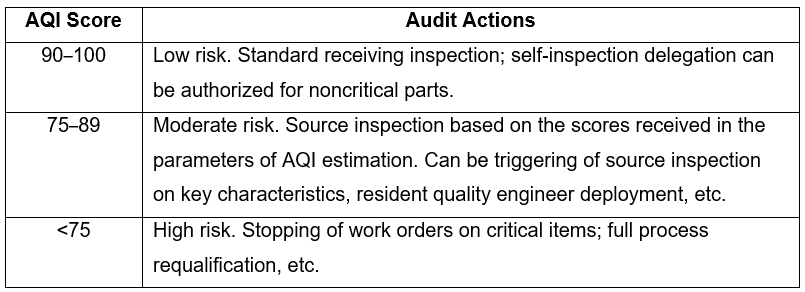
Transitioning to an adaptive supplier audit model converts supplier oversight from a passive calendar exercise into an active risk management strategy. By driving audit schedules through operational data and measuring risk using AQI, quality teams intervene precisely where risk spikes. This approach eliminates nonconforming hardware before it reaches assembly lines, streamlines resource allocation, and strengthens ISO 9001 compliance across the supply chain.
About the author
Suneel Kumar is an aeroengine quality and metrology authority with more than 22 years of experience in aeroengine development. His technical domain spans advanced dimensional metrology, high-precision CMM verification, NDE, and quality assurance frameworks for critical propulsion components. An active researcher and speaker, he has authored technical papers and delivered key presentations at prestigious national and international forums including Metrology Society of India, the Indian Society for Non-Destructive Testing (ISNT), and the Coordinate Metrology Society.